by Duhita Dey
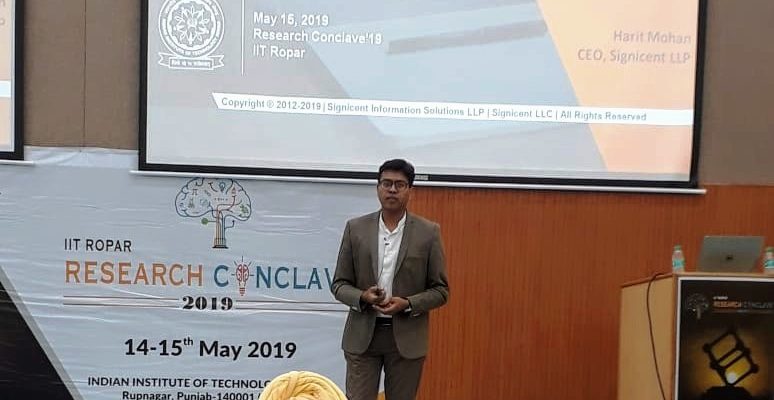
Signcient’s CEO Harit Mohan was invited as a speaker at IIT Ropar Research Conclave 2019 to address researchers and professors on conducting high quality research and breaking the monotonous incremental research.
In his address he stated that India has always been the center of allurement for innovations because of its intense focus on sciences and technology by standing 6th for its scientific publications, 7th for filing patent applications and world’s 3rd largest technology startup hub.
But even with the expanding R&D, more than 90% of Indian startup fails within its first few years. Thus, there are certain critical key elements to deploy to keep the research value high. After the research completion, the question of output usage and commercialization rises.
“You must first patent and then publicize on platforms like YouTube , Facebook, publish papers and articles.”
– Harit Mohan at IIT Ropar Research Conclave 2019
He said that, “you must first patent and then publicize on platforms like YouTube or Facebook, and publish papers or article.” This is the desired sequence of the progression of a high-quality invention as once the invention available as a published art, it becomes freely available and can’t be protected anymore.
The critical elements of high-quality research include 3I’s comprising Innovation, Intellectual property and Industrialization. There are certain aspects which acts as spine to a high-quality research, including-
- A well defined problem statement with a constant objective
- Novelty, the research should be novel/new not already existing (prior art), not an incremental research
- Commercial viability
- Application
- Facing competition
- Diffusion and Implementation
First I is for Innovation: For searching prior arts there are platforms available such as Google Scholar, Science Direct, IEEE, Google patents, Espacenet, USPTO, etc. are available. The systematic analysis of an invention planning is done by Whitespace analysis, by using a matrix called Problem Solution matrix, built after analyzing numerous articles/papers of the research domain with permutations and combinations..
Second I is for Intellectual property (IP): A patent protects and excludes others from selling or using it. It gives patent holder the authority to sue the offender who tries to infringe his/her patented invention. Intellectual property right exists as Copyright, Trademark, Patents, Trade secrets, Industrial designs, etc.
Third I is for Industrialization: This includes commercialization of the invention by licensing the technology, doing a startups, selling the technology and also includes marketing, and monitoring.