by Duhita Dey
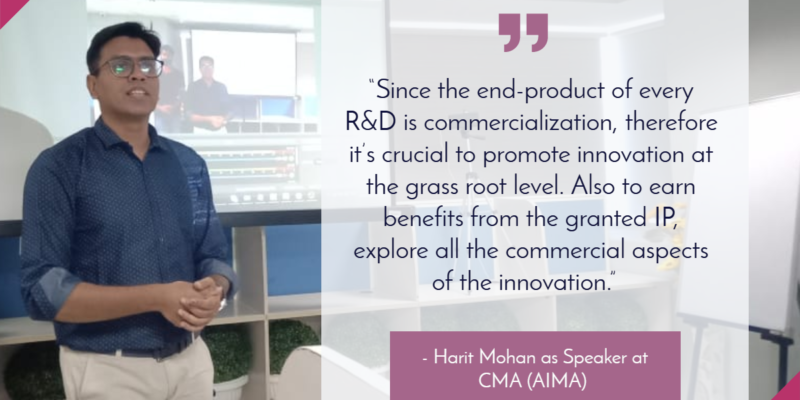
Signcient’s CEO Harit Mohan was invited as a speaker at Chandigarh Management Association, All India Management Association, CMA (AIMA), to address the importance of IPR and digitalization in innovation and trade.
In his address he stated that India, enticing the globe with its ‘Digital Economy’, driven by its smart technologies, transitioning policies and revamping services to fuel its economy. India deliberates over the power of the internet which is vividly reflected by the program called ‘Digital India’.
The world has witnessed the unprecedented transitions by internet and digitalization in the technology domain and also aware of its importance in innovations. IOT and smart devices are revolutionizing our surroundings. The internet by establishing connections, all have ubiquitously integrated into almost every physical device and also into our life. Smart devices such as Alexa, Samsung smart plugs, Chromecast are actively being used by younger generations. These devices are not untouched even by children, voice assistance makes them easily accessible to kids.
From academics to business, IOT is encompassing the advancements to another dimension.
Realizing its intrinsic instinct of technological abilities, India establishes the 9 pillars of ‘Digital India’ to connect rural areas with high-speed internet networks and improve digital literacy. It includes broadband highway, universal access to mobile connectivity, public internet access program, E-governance, electronics manufacturing, IT jobs, E-Kranti electronics delivery service, information for all and early harvest programs. The E-governance plan was set up to promote the percolation of the government services to people and trades and it was laid by the framework of E-Kranti which provides electronic delivery services by the use of integrated and interoperable systems.
Innovation & Digitalization
The dimension of the digital revolution. The digitalization is very crucial for an invention to gain its value, maintain them. And it helps to percolate to the vast customer base in the country.
IP is an essential asset for the valuation of an invention or idea. It gives a competitive edge in the market field and to surveil the competitors or imitators to dissuade them legally.
Following are the case studies from India depicting the current scenario of digitalization
Uttrakhand’s hot air balloon Wi-Fi. Taking forward the idea of digital India, the Uttrakhand govt. launched Wi-Fi fitted in a hot air balloon to connect the remote rural areas. Free Wi-Fi by Google at railway stations. Google collaborated with Indian telecom infrastructure to deploy free Wi-Fi service to 400 railway stations in India. Globalization of the Aadhar card technology. The technology of Aadhar card has been internationalized after the beta testing of this technology over billion of the Indians. India Stack, the application behind Aadhar card, was given the cabinet approval to set up in Singapore under the pact between the two states. India manufactured driverless trains for Sydney. Under the initiative of ‘Make in India’, the Indian origin manufacturer named Alstom has delivered 22 metropolis driverless trains for the very first driverless metro line of Sydney.
Several digital apps have been launched by Indian Prime minister Modi in Singapore such as RuPay, Bhim App and UPI enabled remittance app by State Bank of India with the motive of internationalizing the Indian digital payment platform, remittance of multi-billion dollars and easing the transactions for the Indians residing in Singapore.
Modi has also launched several applications to curb black money and black marketing. There are several applications and online programs to unearth and track black money.