by Duhita Dey
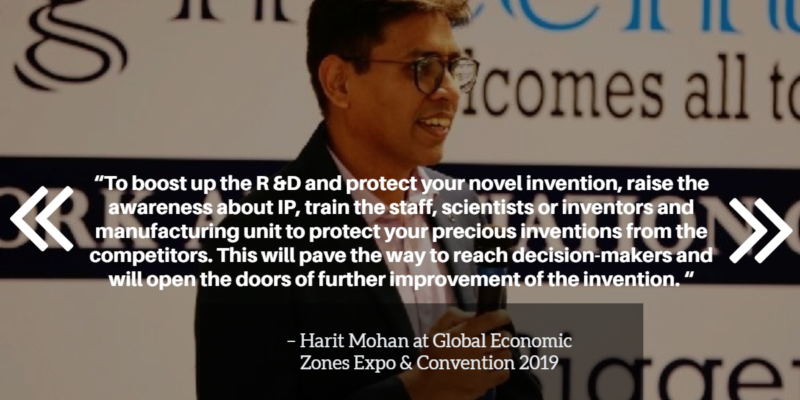
Signcient’s CEO Harit Mohan was invited as a speaker at Global Economic Zones Expo & Convention 2019 to address the industry experts on IPR and startup’s success.
In his address to the industry experts, he stated that India is globally enticed by running on the tracks of the pacy venture of innovations and fortified by the nurturing environment for startups by the government. India is emerging as an attractive economic zone and has lured domestic as well as foreign investments. India is the world’s 3rd third largest startup ecosystem after the US and Britain and is pacing on the fast lane of expanding startups, being backed by more than 50 startup boosting schemes of the Indian government. The numbers of startups and entrepreneurs are elevating and will surge by 5 times in the coming years.
However, even with the great nation’s trade policies, most of the Indian startups after a few years of their inceptions are hardly able to survive. Though we are lauded globally for the intensive focused research on science and technology, the innovations still need to be valued since they remain ‘unprotected’.
On the hind side of global achievements, some figures were stated in his talk. For example, in 2010, only 910 patent applications were filed by Indian startups which comprise 16% of the total Indian startups. Indian patent applicants comprise only 29% of the total patent applications filed in India (of around 45,0000 applications), while the major chunk of patents came from foreign companies such as Procter & Gamble, Unilever, Samsung, Apples, etc. A large number of startups with their ideas unprotected create a huge peephole for the international as well as national competitors to peek into the ideas and inventions. IPR holds the legal power to sue any of the competitors or imitators to copy, sell or use the uniqueness of your invention.
The insight into the growth of IPR in 2016-17 with the comparison of the coming years has been discussed in the talk. There are certain areas of IP where active involvement of Indian companies projects an encouraging scenario for example in Geographical indications and Copyright. Indian manufacturers are aggressively growing in trademark registration, where 85% of the registered trademarks are by Indian companies.
Case studies discussed in the talk:
The trademark tug-off between Prius and Toyota for a hybrid car in India– In 2009, Toyota lost the infringement suit filed against Indian company Prius since the auto spare part maker had been using the trademark ‘Prius’ with the acquired rights from 2002, while Hybrid sedan of Toyota came to India in 2010. Though Toyota had been using the trademark globally but never registered in India and under Indian trademark law, IP rights granted are territorial, not global.
Bayer vs Natko’s compulsory license case over the cancer drug– The Supreme Court of India rejected the appeal of Bayer against the Indian generic drug maker.
TVS vs Bajaj, the patent dispute case- It was a patent infringement controversy between these giant bike makers over the DTSi engine technology in which Bajaj bagged the patent.
Indian Performing Rights Society (IPRS)– The society is chaired by lyricist and writer Javed Akhtar sued Vodafone-idea for using their copyright songs in their caller tune and apps. High court’s verdict came into their favor and the telecom company paid the royalty of Rs 2.5 crores. These cases very vividly speak the scenario of IPR in India. It’s important to raise vigilance about the patenting cost to break the myth of financial constraints. Backed by the subsidy by the Indian government, patenting in the way India is amazingly affordable. The facts and figures given in his talk vividly underline the solution to startup growth and the importance of IPR in the progression of a successful startup nation. Thus, IPR is a very necessary tool needed in a rising economic zone in India to protect the IP, he concluded.